IRB Infrastructure Developers has signed a share purchase agreement to shift Solapur Yedeshi Tollway and CG Tollway out of its GIC-backed private InvI


insghits
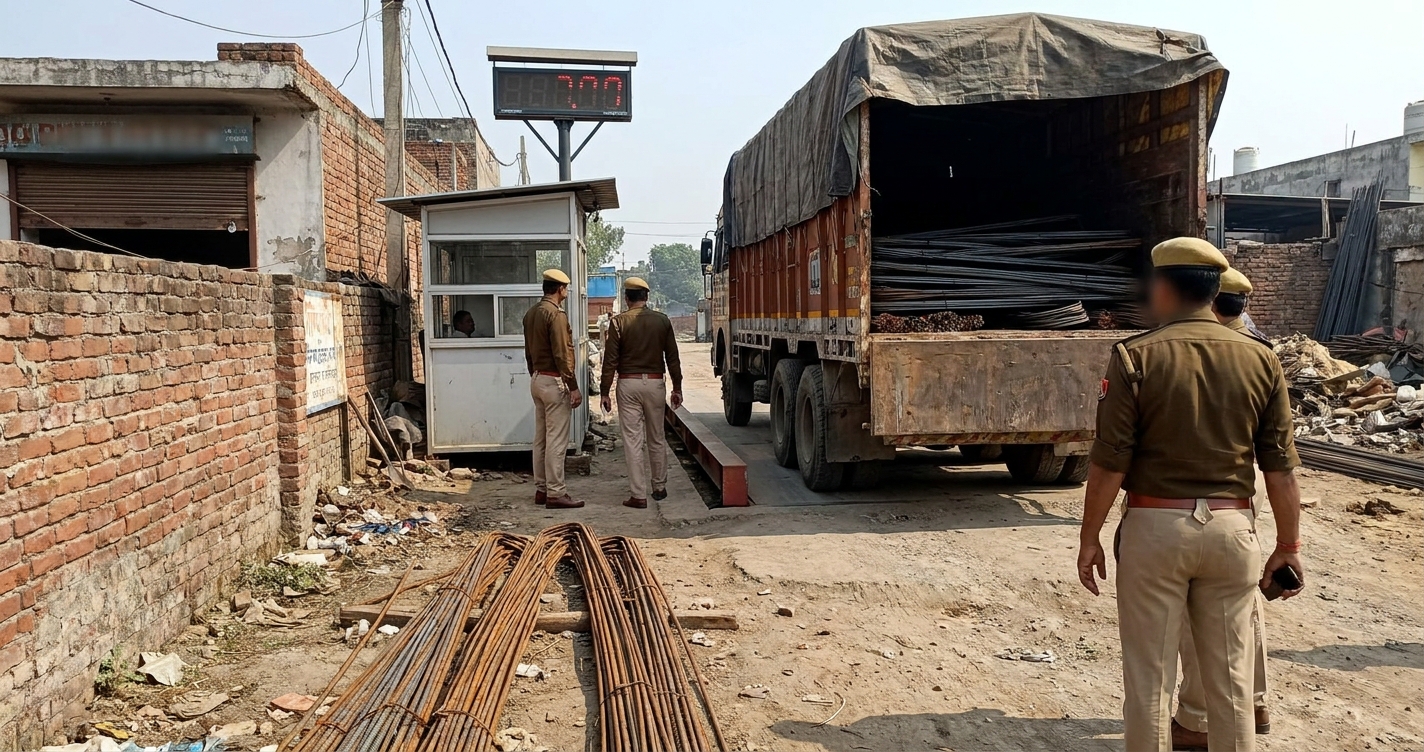
The Kavinagar police station's Ghaziabad operation — which recovered 42 tonnes of steel reinforcement and arrested Musarruf, Osama, Imran and Prashant — reads as a routine crime report.
For contractors and developers moving rebar across Uttar Pradesh, it is a material-governance warning running undetected for roughly three years.
The method was not a crude hijacking. Trucks carrying TMT to a Baghpat site at Nethli were diverted to a warehouse, partially unloaded, then driven to a weighbridge where an electronic chip or remote device reset the displayed weight to the original loaded figure.
The weighment slip — the document contractors typically accept as proof of delivery and the basis of invoice reconciliation — was handed over as though the full consignment had arrived. Official records showed complete delivery while the material had already left the supply chain.
The commercial exposure sits with whoever owns the material between dispatch and site receipt. Under delivered-to-site terms, that is frequently the supplier or its transporter; under many EPC arrangements, the contractor carries shrinkage as unrecovered material cost.
At prevailing TMT rates, a single 42-tonne seizure represents tens of lakhs of rupees. Across three years and multiple unnamed construction companies, cumulative leakage is the kind of loss that rarely surfaces as theft — it appears as over-consumption and reconciliation variance.
Ghaziabad Police's investigation now extends to weighbridge operators and employees, which points to the structural weakness: the weighbridge is a single, human-dependent control point.
Where weighment is not integrated into ERP, a slip is not verification — it is a claim. The missing controls include:
- No tamper-evident seal
- No route geofencing
- No dispatch-and-receipt dual weighment
- No random re-weighment at site
The absconding suspects, Raj Kumar alias Raju, Lokesh Sharma and Aftab, with Raju and Aftab previously jailed in similar cases, show the fraud was repeatable precisely because detection controls were weak.
The signal for infrastructure execution is that material attestation is shifting from analogue weighbridge slips to multi-point digital reconciliation.
The emerging control set includes:
- RFID-tagged bundles counted rather than weighed
- Calibrated and certified weighbridges
- Geofenced deviation alerts
- Tamper-evident seals written into supplier rate contracts
Developers and EPC contractors should treat the weighbridge slip as non-conclusive evidence and price transit control as a procurement cost, not an administrative afterthought.
Insights

IRB Infrastructure Developers has signed a share purchase agreement to shift Solapur Yedeshi Tollway and CG Tollway out of its GIC-backed private InvI

The Supreme Court's NEEPCO v Astra Construction ruling confirms a contractual interest bar can strip pre-reference interest from arbitral awards, turn

NHAI and Sardar Sarovar Narmada Nigam Limited have signed a time-bound framework for National Highway, canal and pipeline crossings in Gujarat, waivin


Powered by

© Tuskus 2025 - All Rights Reserved by Teamic Creative Lab Pvt. Ltd.
